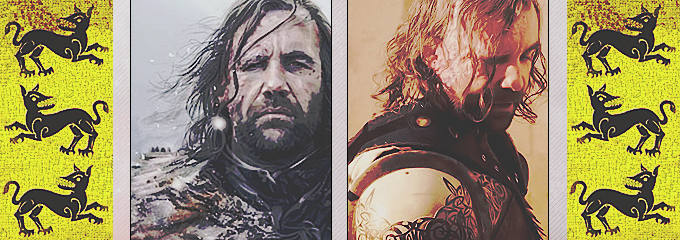
I need everyone to understand that these are not the same version of Sandor Clegane.
Well, technically, they are, but adapted through two entirely different emotional lenses.
Now, before anyone arrives at my house with pitchforks and a twenty-tweet thread about trauma, let me clarify something.
I love Sandor.
Deeply.
Unfortunately, book Sandor is also an absolute shithead.
This is important to acknowledge because fandom has a tendency to romanticise Sandor so aggressively that people begin talking about him as though he is secretly some wounded gothic prince trapped beneath layers of emotional repression. And if Book Sandor heard that description, he’d probably call you an idiot before threatening someone with a knife.
Because book Sandor is aggressive, misogynistic, volatile, emotionally manipulative, frighteningly unstable and often frightening in ways the television version rarely is.
George R. R. Martin writes him completely unsanitised for audience comfort. A man shaped by violence who has internalised violence as his primary emotional language. His trauma explains him, but it does not soften him. If anything, it sharpens him into something uglier.
Part of what makes Book Sandor fascinating is that we never actually inhabit his head. We see him through the eyes of other people.
Sansa is particularly important here because some readers retroactively sanitise their dynamic. The emotional complexity is real, but so is the discomfort. Through Sansa’s perspective, we are watching a teenage girl trying to make sense of a frightening, contradictory man who oscillates between vulnerability and menace.
The tension works precisely because neither interpretation fully cancels out the other.
Which is there.
But so is the menace, and the deeply uncomfortable power imbalance between a young girl and an adult man with authority over her.
Sandor is compelling precisely because he occupies this horrible emotional space between protector and threat. He is capable of startling vulnerability immediately followed by behaviour that reminds you he has spent his entire life marinating in brutality.
Book Sandor does not know how to exist outside violence. Even his honesty arrives sharpened into cruelty.
He is not safe.
And I think the books understand that very clearly.

Now, series Sandor Clegane?
Somehow, despite being the same man, he feels like he wandered in from a completely different story.
Series Sandor is somehow still terrifying, but also accidentally one of the funniest people in Westeros.
And that changes everything.
Series Sandor feels tired before he feels dangerous.
We know he’s dangerous. The show establishes that immediately through Mycah’s death, through Joffrey’s descriptions of him, through Baelish’s observations, and through Sandor’s own actions. His reputation is earned.
But once that’s established, the dominant emotional impression isn’t menace. It’s exhaustion.
Television Sandor retains the brutality and emotional damage, but gains something the books don’t reveal: visible exhaustion with everybody around him.
Which ends up being humorous.
Series Sandor moves through Westeros like a man who has reached the absolute limit of human patience. Everyone else is giving speeches about honour, destiny, kinship or prophecy while he stands in the background looking like he wants civilisation itself to end.
His humour works because it never feels like comic relief in the traditional sense. He is funny because his worldview is brutally direct in a setting full of hypocrisy and theatrical self-importance.
Every conversation sounds like.
“All of you are ridiculous, and I hate being here.”
The show leans much more heavily into Sandor’s dry sarcasm and reluctant emotional awareness. His dynamic with Arya becomes entertaining because he spends most of their journey oscillating between: accidental father figure, emotionally constipated protector and homicidal babysitter.
One of the best things the show understands is that Sandor’s cynicism becomes darkly comedic because its often completely accurate. He cuts through fantasy heroism with the energy of a man who has seen too much horror to tolerate romantic nonsense anymore.
But, importantly, the humour never erases the sadness underneath him.
Beneath the sarcasm and violence is still a man profoundly shaped by fear, abuse, humiliation and emotional isolation. The humour simply makes him feel more human, because real damaged people are often funny. Especially the ones trying not to reveal they care about anything.
Series Sandor softens the edges of the character without betraying who he is. The audience is allowed to spend more time with the exhausted humanity beneath the rage. We see more moments of restraint. More awkward tenderness. More reluctant conscience.
Book Sandor just feels like someone barely containing violence.
Series Sandor feels like someone reluctantly rediscovering fragments of humanity against his own will.
One is a deeply damaged man who frightens us.
The other is a deeply damaged man who makes us laugh before breaking our hearts a little
Emotionally, those are two very different experiences.
The difference isn’t what happened to Sandor Clegane. The difference is which parts of him each version chooses to show us.
Discover more from Dark Gothic Fantasy by J.L. Coulbeck
Subscribe to get the latest posts sent to your email.